Revenue and profit are two of the most important numbers in ecommerce, yet they are often confused. Many Shopify founders celebrate rising sales without realizing their business is making little profit, or even losing money. High revenue looks impressive, but it does not tell you whether your business is financially healthy.
Understanding the difference between revenue and profit changes the way you make decisions. It helps you price products correctly, control costs, and focus on growth that actually improves your bottom line instead of simply increasing sales.
This guide explains the difference between revenue and profit, why Shopify founders often confuse the two, and how to track both metrics to build a more profitable ecommerce business.
WHAT YOU’LL LEARN
- Why revenue and profit are fundamentally different measures
- The four most common ways Shopify founders confuse the two
- A clear framework for tracking both, and knowing which to optimise
- The one question that separates healthy growth from dangerous growth
Revenue: What It Measures and What It Doesn’t
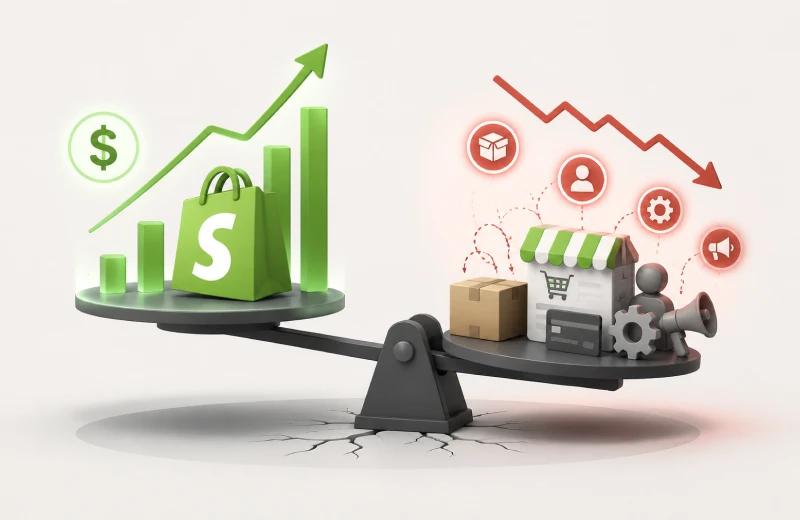
Revenue is the total money your store brings in before you subtract any costs. In Shopify, this usually appears as gross sales or net sales after discounts and returns. It is a measure of commercial activity, how much your customers are buying from you. What revenue does not tell you: whether the business is sustainable, whether you can afford to keep operating, or whether growth is actually making you better off. A business can grow revenue by 40% year over year and become less viable if costs grow even faster.
Profit: What It Measures and Why It’s Harder to Find
Profit is what remains after every cost has been paid. There is more than one way to measure profit, and using the wrong one at the wrong stage leads to poor decisions.
Metric |
What It Measures |
When to Use It |
| Gross Profit | Revenue minus COGS only | Product economics, is my pricing viable? |
| Contribution Margin | Revenue minus all variable costs | Unit economics, does each order make money? |
| Operating Profit | Gross profit minus operating expenses | Business efficiency, can I cover overhead? |
| Net Profit | All revenue minus all costs | True financial health, am I actually profitable? |
Most Shopify founders are looking at gross profit (or sometimes just revenue) when they should be looking at contribution margin and net profit. The gap between those numbers is where many businesses start making expensive mistakes.
Common Revenue vs. Profit Mistakes
1. Treating gross revenue as available cash
Your Shopify gross revenue includes VAT/sales tax you collected for the government, returns you haven’t yet processed, and discounts already applied. None of that is profit. It isn’t even fully yours. Always work from net revenue, after taxes, returns, and discounts.
2. Celebrating revenue growth without checking margin
If your revenue grew 30% but your contribution margin dropped from 35% to 22%, you made less profit on a larger turnover. This commonly happens when brands run large promotions, increase ad spend rapidly, or take on wholesale orders at lower margin. Revenue growth without margin stability is not necessarily progress.
3. Using platform ROAS as a profit metric
Meta reporting a ROAS of 4.2 means it believes your revenue was 4.2 times your ad spend on that platform. It says nothing about profit. A campaign generating $10,000 in revenue at 4.2 ROAS on a product with 30% contribution margin after all costs generated $3,000 in contribution, before subtracting fixed costs. Always convert ROAS to contribution margin before drawing conclusions.
4. Scaling revenue before understanding unit economics
The most financially dangerous version of this confusion: spending aggressively on customer acquisition to grow revenue, without having confirmed that contribution margin per order is positive. Scaling a business with negative unit economics makes every order worse, not better. Confirm your CM is positive before scaling.
THE GROWTH TRAP
The most common version of this confusion looks like this: revenue is growing, the founder feels momentum, they reinvest everything into ads to keep growing, and twelve months later they have tripled the revenue and half the cash. The business grew its way into a cash crisis because profit was never measured alongside revenue. This is not rare, it is one of the most common DTC failure modes.
A Framework for Tracking Both
The practical solution is to track revenue and profit at different cadences, for different purposes:
| Metric | Check When | Decision It Informs |
| Gross & Net Revenue | Daily / Weekly | Is the business generating commercial activity? |
| Contribution Margin | Weekly / Monthly | Are orders profitable? Is scaling justified? |
| CAC & ROAS | Weekly | Is marketing spent generating returns? |
| Net Profit Margin | Monthly | Is the business financially healthy overall? |
| LTV:CAC Ratio | Monthly | Are customer relationships creating long term value? |
The question that keeps both numbers honest: ‘If I double revenue tomorrow, does net profit also increase?’ If the answer is ‘I don’t know’, you need better visibility into your cost structure before making growth decisions.
Closing Thoughts
Revenue is a necessary measure of whether your store is generating activity. Profit is the only measure of whether that activity is sustainable. The founders who build durable businesses are the ones who hold both numbers in view simultaneously, and who never confuse one for the other. If your weekly review starts and ends with the revenue dashboard, you are making decisions with half the information you need.
Key Takeaways
- Revenue measures commercial activity. Profit measures financial health. They are not the same number.
- A store can grow revenue 40% year over year and become less viable if costs outpace growth
- Gross profit only subtracts COGS. Contribution margin subtracts all variable costs. Net profit subtracts everything.
- Shopify’s gross revenue includes tax and pending returns, always work from net revenue for any financial decision
- Platform ROAS is a marketing metric, not a profitability metric, convert it to contribution margin to draw useful conclusions
- Scaling a business with negative unit economics makes the problem bigger with every order
- The growth trap: revenue rising, profit stagnant or falling, common in brands that reinvest into acquisition without confirming margins
- Track revenue daily/weekly for commercial decisions; track contribution margin and net profit monthly for strategic decisions
See Revenue and Profit in One Place
Most Shopify brands track revenue daily and check profit quarterly, if at all. The gap between those two cadences is where margin problems develop unnoticed. DataAnalyticsStack builds Financial & Profitability dashboards that show net revenue, contribution margin, and net profit by channel, by product, and by month, so you always have both numbers in view when making decisions.
Contact us today to see how your store is really performing.