Most Shopify stores generate the majority of their profit from a surprisingly small group of customers. In many cases, the top 20% of customers account for around 80% of total profit. Yet many businesses still treat every customer the same, missing one of the biggest opportunities for sustainable growth.
Instead of identifying who their most valuable customers are, many brands send the same emails, show the same offers, and run the same retargeting ads for everyone. That approach may deliver average results, but it rarely builds a customer base that drives long term profitability.
Identifying your most profitable customers is not about ignoring everyone else. It is about understanding who creates the most value for your business, what brought them to your store, and how to attract more customers like them.
This guide explains how to identify your highest value customers, use the RFM framework to segment them, uncover the acquisition channels that bring them in, and turn those insights into a repeatable growth strategy.
WHAT YOU’LL LEARN
- Why your best customers and your biggest spenders are often different people
- The RFM framework: the clearest way to segment customer profitability
- How to use customer data to find acquisition channels that bring high value buyers
- Four actions to take once you’ve identified your top segment
Why Revenue Doesn’t Always Equal Profitabilit

A customer who spent $800 in one transaction and never came back is less valuable than a customer who spent $120 three times in 12 months. The first customer generated more revenue per order. The second customer generated more profit, because there was no acquisition cost on orders two and three, and no return to process.
True customer profitability combines three dimensions:
- How much they spend per order
- How often they buy
- How recently they were active
This is the foundation of RFM analysis.
The RFM Framework: Your Customer Profitability Map
RFM (Recency, Frequency, Monetary), is the most practical way to rank and segment customers by actual value. It requires no complex modelling: just your order history data.
| Dimension Recency | What It Measures | Why It Matters |
| Recency | Days since last purchase | Recent buyers are more likely to buy again |
| Frequency | Number of purchases (period) | High frequency = loyalty and product fit |
| Monetary | Total spend or avg order | Identifies your highest value buyers |
Score each customer 1–5 on each dimension, combine the scores, and you have a clear hierarchy of customer value. Customers scoring high on all three (5-5-5) are your Champions, the segment to understand deeply and actively replicate.
RFM SCORING IN PRACTICE
- Recency score: 5 = purchased in last 30 days; 1 = over 365 days ago
- Frequency score: 5 = 5+ purchases; 1 = 1 purchase only
- Monetary score: 5 = top 20% by spend; 1 = bottom 20%
- Champion customer: R5, F5, M5, recent, frequent, high spend
- At risk customer: R1–2, F3–5, M3–5, loyal but lapsing
For Shopify stores, RFM analysis is one of the simplest ways to identify your most valuable customer segments without complex data modelling.
What Your Best Customers Actually Look Like
Once you’ve identified your top customer segment, analyse the following customer characteristics:
- Which acquisition channel did they come from? (Meta, Google, email, organic, referral)
- What was their first product purchased?
- What geographic region or demographic do they cluster in?
- How long between their first and second purchase?
- What is their average order value compared to your overall AOV?
The answers tell you where to find more customers like them. If your Champions disproportionately came from organic search and converted on a specific product page, that is a signal to invest in SEO for that product. If they came from a referral or a particular Meta campaign creative, scale that channel.
Why High Value Customers Matter
Research from Polar Analytics shows that the top 1% of ecommerce customers can be worth up to 18 times more than the average customer. Identifying and protecting this segment, and understanding what brought them to your store, is one of the highest leverage analytics exercises available to a Shopify founder.
How to Grow Your Most Profitable Customer Segment
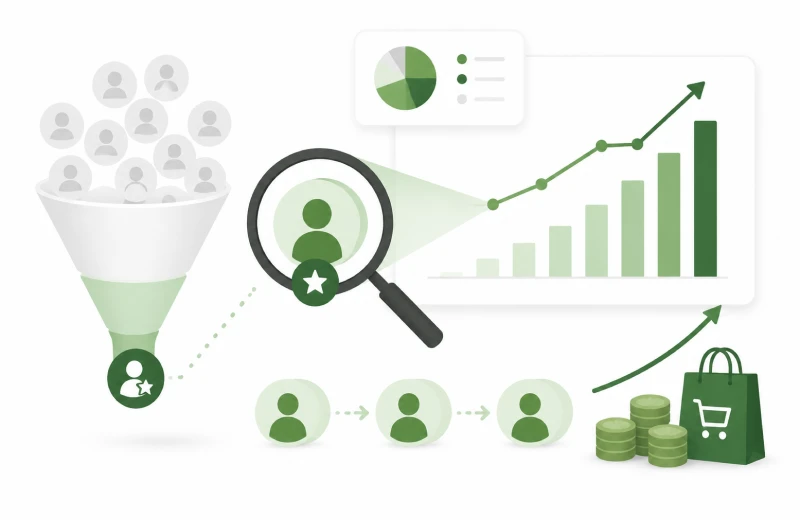
1. Build a lookalike audience from your top segment
Export your Champion and high value customer list and upload it to Meta and Google Ads as a custom audience. Use this as the seed for lookalike targeting. Customers acquired through lookalike audiences built from high LTV seeds consistently outperform audiences built from all customers.
2. Protect your Champions with VIP treatment
VIP customers generate 73% higher AOV and complete 3.6x more purchases than standard customers. Give them early access to new products, exclusive offers, and a direct line to your team. The goal is to make sure these customers never have a reason to look at a competitor.
3. Investigate your first product for high value buyers
If Champions disproportionately purchased a specific product first, that product is your highest value entry point. Invest in driving more traffic to its page, improve its conversion rate, and feature it more prominently in acquisition campaigns.
4. Run a win back campaign for at risk
Champions Customers who have all the hallmarks of Champions but haven’t purchased recently are your highest probability win back targets. A personalised email acknowledging their absence, with a specific, product relevant offer rather than a generic discount, typically converts at 15–25% for this segment.
Avoid Treating Every Customer the Same
Brands that send identical email campaigns to all segments consistently underperform those that segment by RFM. A win back campaign sent to a Champion is very different from the right message for a one time buyer. Treating all customers identically is the single most common retention mistake in ecommerce.
Closing Thought
Your most profitable customers are already in your data. Most brands just haven’t looked. Running a basic RFM analysis takes a few hours with your order history data, and the insights it surfaces will change how you think about acquisition targeting, email marketing, and product strategy simultaneously. Understanding who your best customers are is nice to have. It is the analytical foundation for building a brand that compounds rather than churns.
Key Takeaways
- The top 20% of customers typically generate 80% of profit, but revenue based sorting does not reveal who they are
- RFM analysis (Recency, Frequency, Monetary) is the most practical framework for identifying true customer profitability
- A customer who buys three times at lower order values is usually worth more than a one time high spender
- Champions, customers who score high on all three RFM dimensions, are the segment to understand and replicate
- Pulling your Champions’ acquisition channel data reveals which sources bring high value buyers
- Lookalike audiences built from high LTV customer seeds consistently outperform generic audience targeting
- VIP customers generate 73% higher AOV and 3.6x more purchases than standard customers
- First product analysis often reveals a high value entry point to promote more aggressively
- Win back campaigns for at risk Champions convert at 15–25% when personalised correctly.
Need Better Customer Insights?
Customer analytics goes beyond average LTV. The insight is in the segments, which customers are truly driving your growth, where they came from, and what keeps them coming back.
DataAnalyticsStack helps ecommerce brands identify their highest value customers, track customer lifetime value, and understand which acquisition channels drive long term growth.