A good gross profit margin for eCommerce is 50%–70%. This range gives businesses enough room to cover operating costs and invest in growth, while margins above 70% are considered excellent.
Ask ten Shopify founders what their margin is and most of them will quote you their gross margin. Ask them their net margin and most will give you a long pause. The gap between those two numbers is where most DTC brands silently lose their profit, and chasing the wrong benchmark is one of the fastest ways to scale.
This article will guide you on what a good gross profit margin is for ecommerce, how to calculate it, and give you the floor your business needs before you start scaling ad spend.
WHAT YOU’LL LEARN
✓ What is gross margin?
✓ How to calculate gross margin?
✓ Good gross margin for ecommerce
✓ 2026 gross margin benchmarks by ecommerce vertical
✓Why gross margin is not the same as profitability
✓ What a healthy contribution margin looks like
What is Gross Margin?

Gross margin is the percentage of money your business keeps after paying the direct costs of making or buying the products you sell. These costs usually include things like raw materials, manufacturing or wholesale purchase costs.
It does not include other business expenses such as rent, marketing, salaries or software subscriptions. A higher gross margin means you have more money left to cover those costs and earn a profit.
How to Calculate Gross Margin?
To calculate gross margin, subtract the cost of goods sold (COGS) from your total sales revenue. Multiply the answer by 100 to get the percentage.
Gross Margin (%) = ((Revenue – Cost of Goods Sold) ÷ Revenue) x 100
Let’s say your Shopify store makes $5,000 in sales and the products you sold cost $3,000. Your gross profit is $2,000.
Gross Margin = (($5,000 – $3,000) ÷ $5,000) x100 = 40%
This means you keep $40 from every $100 in sales after paying for the cost of your product.
Good Gross Margin for Ecommerce
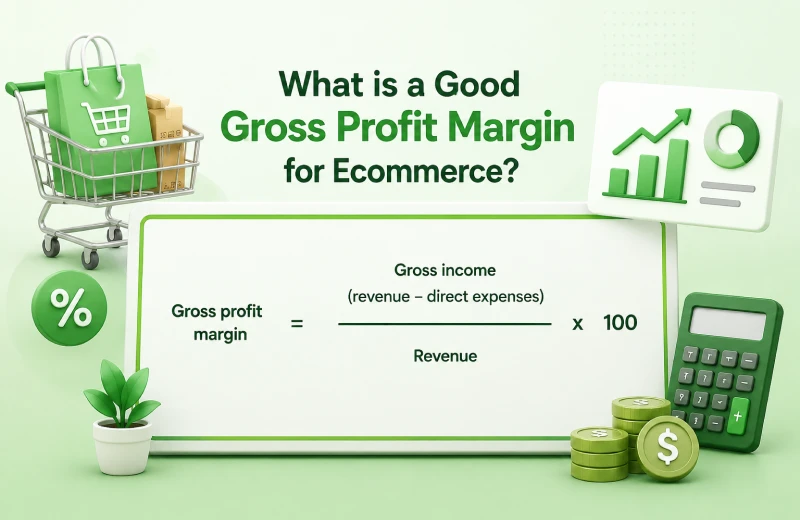
A good gross margin for an Ecommerce business depends on what you sell, but 50% – 70% is considered healthy for many online stores. Margins above 70% are considered excellent. Businesses with unique or branded products may have higher margins, while stores that sell low cost or highly competitive products may have lower ones.
Instead of comparing your store to every competitor, focus on maintaining a margin that covers your business expenses while still leaving room for profit. If your gross margin is too low, you may need to review your pricing, product costs or supplier agreements.
2026 Gross Margin Benchmarks by Vertical
Gross margins vary enormously by product category. The benchmarks below are for Shopify DTC brands selling primarily through their own store. Brands selling through Amazon or wholesale will show lower effective margins due to fees and markdowns.
Why Gross Margin Is Not the Same as Profitability
This is where most founders get confused. Gross margin only subtracts what you paid for the product. It says nothing about what you spent getting it to your customer, finding that customer in the first place, or keeping the business running.
Here is what a 70% gross margin actually looks like after the remaining cost layers are applied to a typical Shopify DTC skincare order:
That 70% gross margin becomes 20% net margin once all costs are loaded and that is actually a good outcome. For brands with lower gross margins, that journey from 60% gross to net profit can easily end in single digits or negative.
What a Healthy Contribution Margin Looks Like
Contribution margin shows your real profit from each order after covering costs like shipping, payment processing, and ad spend, so it’s more useful than gross margin alone.
For DTC brands, a healthy contribution margin after all variable costs is above 30%. Below 20% and scaling becomes very difficult. Below 10% means the business is not generating real profit per order.
Direct to consumer brands across apparel, beauty, and lifestyle categories achieve 30–40% contribution margins when properly optimised. This is the benchmark to aim for, not gross margin in isolation.
Closing Thoughts
Gross Margin is an important number, but it should never be viewed on its own. It tells you whether your products are priced well enough to cover their direct costs, but it cannot tell you whether your business is truly profitable.
The brands that grow profitably are the ones that trace the full journey from gross margin to net profit, understand which cost layers are compressing their returns, and make decisions based on contribution margin, not the number Shopify shows on the dashboard.
Key Takeaways
- Gross margin measures product economics, not business profitability
- Beauty and skincare brands lead with 65–85% gross margins in 2026
- The average Shopify DTC brand runs 50–65% gross margin before fulfillment and ad costs
- Brands with gross margins above 70% are significantly more likely to scale profitably
- A 70% gross margin typically becomes 20–30% net margin after all cost layers
- Contribution margin (after shipping, processing, and ad spend) is a better unit economics metric than gross margin
- Target 30%+ contribution margin before aggressively scaling ad spend
- Electronics and low margin categories require very high volume to generate meaningful absolute profit
- Amazon channels reduce effective gross margin by 13–20 percentage points compared to Shopify DTC
Know Your Real Margins, Not Just Gross
DataAnalyticsStack builds financial and profitability dashboards that trace the full margin journey from gross revenue to net profit, so you always know exactly where your money goes.