Many Shopify founders assume every sale makes money. In reality, the first order often recovers only part of the cost of acquiring a new customer. Rising advertising costs have made this an even bigger challenge. For many ecommerce brands, the first purchase breaks even at best or loses money altogether.
That does not mean your business is failing. It means long term profitability depends on what happens after the first purchase. If customers come back, your acquisition cost gets spread across multiple orders. If they never return, your business has to keep paying to replace them.
This guide explains why first order profitability is so difficult to achieve, how to measure whether your customer acquisition costs are sustainable, and what turns a first time buyer into a profitable long term customer.
WHAT YOU’LL LEARN
- Why the first order is almost never profitable on its own
- The CAC payback problem, and what it means for your growth strategy
- How to calculate whether your first order economics are sustainable
- The three things that determine whether a first time buyer becomes profitable
The CAC Payback Problem
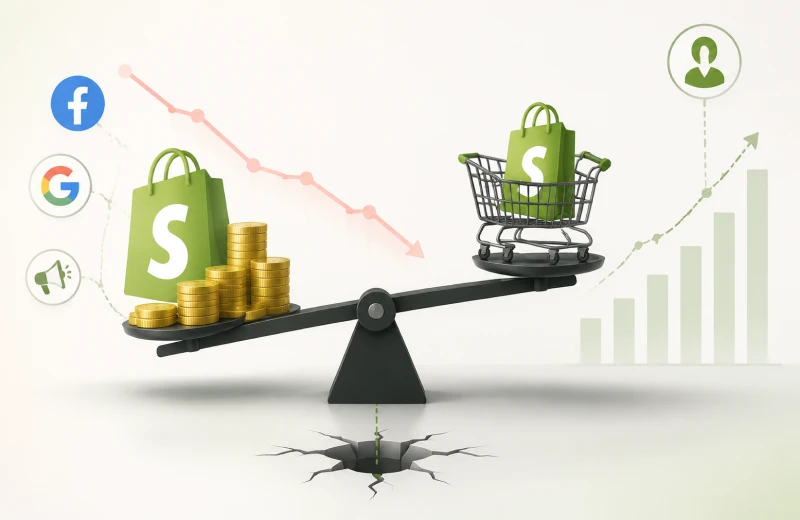
CAC payback period is the number of months it takes for the revenue (or margin) from a customer to recover the cost of acquiring them. For DTC brands with high acquisition costs, this payback period is often 6–12 months, which means most brands are cash flow negative on a new customer for the better part of a year before that customer relationship starts generating profit.
CAC PAYBACK CALCULATION
- Payback (months) = CAC ÷ (Monthly Gross Profit per Customer)
- Example: $140 CAC ÷ $22 monthly gross profit = 6.4 months payback
If your payback period is longer than six months, strong customer retention becomes essential. Otherwise, many customers leave before you recover your acquisition costs.
What a First Order P&L; Actually Looks Like
Here is the unit economics of a typical $80 first order for a DTC apparel brand, including customer acquisition cost:
| Line Item | Amount | Notes |
| Gross Revenue | $80.00 | Selling price |
| Less: Returns (est.) | −$12.00 | 15% return rate allocation |
| Net Revenue | $68.00 | |
| Less: COGS | −$24.00 | 30% of gross revenue |
| Less: Shipping | −$8.00 | Outbound fulfilment |
| Less: Payment fees | −$2.40 | ~3% processing |
| Contribution Margin | $33.60 | 42% before marketing |
| Less: CAC (allocated) | −$40.00 | Blended ad spend per new customer |
| First Order Net | −$6.40 | LOSS on first transaction |
At first glance, the order looks profitable because the contribution margin is 42%. Once customer acquisition cost is included, however, the first order generates a $6.40 loss. The business only becomes profitable when that customer places a second order without another acquisition cost.
These numbers explain why first order profitability has become such a challenge for many DTC brands. Research from SimplicityDX found that brands lose $29 on average for every new customer acquired, while customer acquisition costs have increased by 222% over the past decade. Industry benchmarks also place median customer acquisition costs at roughly $130–156 per customer for many U.S. ecommerce brands.
What Makes a First Time Buyer Profitable?

1. Whether They Buy Again Within 90 Days
The 90 day window after the first purchase is the most critical period in a customer relationship. Customers who buy again within 90 days have much higher lifetime value (LTV) and repeat purchase rates. Those who don’t buy within 90 days are far less likely to ever return. Your post purchase email sequence must give this period special attention.
2. The Quality of Your Post Purchase Experience
45% of customers who switch brands do so because of poor customer service. A slow delivery, a confusing returns process, or no communication after the order confirmation is enough to kill a relationship that cost you $140 to start. The post purchase experience is more than shipping and fulfillment. It is a critical marketing touchpoint.
3. Whether Your CAC Is Matched to Your LTV
The question is not whether you lose money on a first order, most brands do. The question is whether your LTV is high enough to make the total customer relationship profitable. An LTV:CAC ratio of 3:1 is the typical minimum target. If your LTV is $150 and your CAC is $140, your economics are financially unsustainable regardless of how good your margins look on any individual order.
THE CRITICAL INSIGHT
First order loss is not a failure, it is the model. The failure is not having a retention system that recovers the investment. A brand that loses $6 on every first order but achieves a 35% repeat purchase rate and $320 LTV is an excellent business. A brand that loses $6 on every first order and has a 15% repeat rate is running out of runway.
Closing Thoughts
First order profitability is almost a red herring. The real question is whether your total customer economics work. A first order that loses $6 and generates a customer worth $300 over 3 years is a great investment. The brands that understand this build retention systems that systematically recover acquisition costs through second and third orders. The brands that don’t understand this keep raising ad budgets and wondering why the bank account doesn’t grow with revenue.
Key Takeaways
- The average DTC brand loses $29 on a newly acquired customer’s first order
- CAC has risen 222% over the past decade, the economics of acquisition have fundamentally changed
- Recent industry benchmarks place the median DTC CAC between $130 and $156 per customer.
- Losing money on the first order is normal for many DTC brands. The business becomes profitable on the second purchase
- The 90 day window after first purchase is critical: buyers who repurchase within 90 days have dramatically higher LTV
- LTV:CAC ratio below 2:1 means the customer relationship never becomes profitable
- Poor post purchase experience kills retention before it starts
- The question is not whether you lose on order one, it is whether your LTV is high enough to recover it
Understand Your True Customer Economics
Most Shopify dashboards show you revenue per order, not profit per customer relationship. The insight that changes decisions is whether your LTV:CAC ratio works and whether your retention system is recovering your acquisition costs. DataAnalyticsStack builds Customer Analytics dashboards that track LTV, CAC, payback period, and retention, so you always know whether your customer economics are sustainable before you scale.
Contact us today to build a dashboard that shows your true customer profitability.